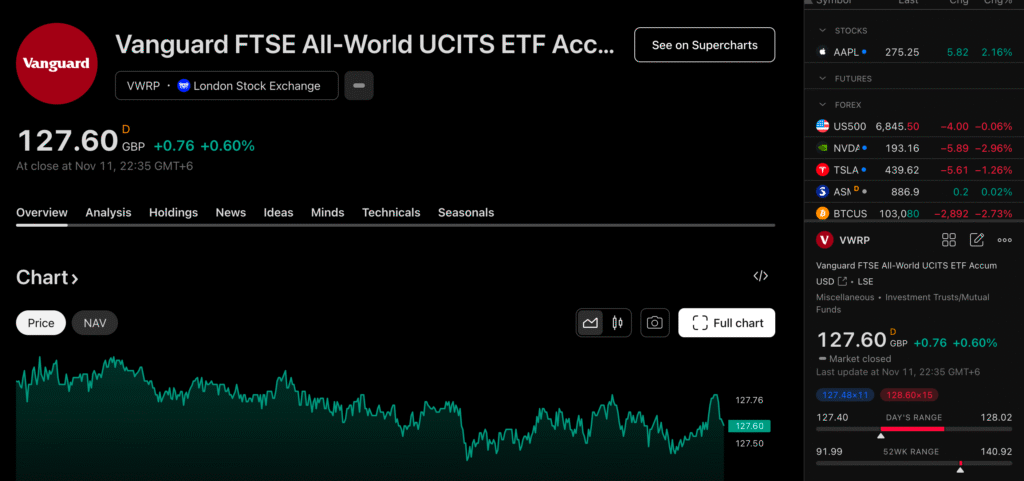
VWRP at a Glance

VWRP is one of the simplest ways to invest in the global stock market through a single ETF. It’s the accumulating version of Vanguard’s FTSE All-World UCITS fund, which means all dividends are automatically reinvested inside the ETF. For long-term investors, especially beginners, this removes the need to handle dividend payments or reinvest them manually.

When I first started building my own portfolio, I wanted something diversified, low-cost, and easy to manage. VWRP checked all those boxes. Instead of choosing dozens of individual stocks, VWRP gave me exposure to thousands of companies across developed and emerging markets. The share price moves with the overall direction of world markets, so you’re buying long-term global growth rather than trying to pick winners.

The main appeal of VWRP is simplicity: one fund, global coverage, automatic compounding, and low annual fees. It’s a solid core holding for anyone beginning their investment journey and looking for a “set it and stay consistent” style of portfolio.

If you want to start investing in VWRP, choosing a reliable, low-fee broker is the first important step. A good platform makes buying, holding, and tracking VWRP smooth and cost-effective.

Today’s VWRP Share Price and What It Means

The VWRP share price changes throughout the trading day as global markets rise or fall. Because VWRP tracks the FTSE All-World Index, its price reflects the combined performance of thousands of companies around the world. When major markets like the U.S., Europe, or Asia move, VWRP usually moves with them.

One of the first things I noticed when I started investing in ETFs like VWRP is that the price doesn’t always match the fund’s exact net asset value (NAV). This is normal. ETFs trade on exchanges like regular stocks, so the market price can be slightly higher or lower than the underlying value—especially during times of high volatility. For beginners, this is nothing to worry about; spreads are usually tight for large, popular ETFs like VWRP.

Another point to keep in mind is currency. VWRP is listed on different exchanges and in different currencies. If your account is not in the same currency as the listing you buy, your final return will also be influenced by exchange rates. I learned this early on when buying my first international ETF—currency shifts can boost returns or slightly drag them down, depending on timing.

When you check the VWRP share price, think of it as a snapshot of the current global market mood. It’s not something you need to monitor every day, especially if your strategy is long-term investing or monthly DCA. The key is understanding what drives the price and focusing on consistency rather than short-term movements.

Before you invest, check the live price on your broker’s platform, because they provide the most accurate and up-to-date value. A reliable broker also helps ensure tighter spreads, smoother execution, and fair trading costs.

What Is VWRP?

VWRP is an ETF from Vanguard that tracks the FTSE All-World Index, giving you exposure to a huge slice of the global stock market in one investment. It holds companies from both developed and emerging markets, covering major regions like the United States, Europe, Asia, and more. Instead of selecting individual stocks, you get a ready-made portfolio with thousands of companies inside.

One reason I was drawn to VWRP early in my investing journey is its structure as an accumulating ETF. This means it doesn’t pay out dividends in cash. Instead, the fund automatically reinvests them. For beginners, this is incredibly convenient. You don’t have to think about handling dividend payments or figuring out when to reinvest—they are quietly added back into the fund and help your investment grow over time. It’s a form of built-in compounding.

Costs are another reason VWRP is popular. Vanguard is known for low fees, and this ETF follows that same philosophy. Lower fees matter more than most beginners realize. In my experience, even a small difference in annual cost can add up significantly over decades.

VWRP is also a UCITS-compliant fund, which means it meets strict European regulatory standards. This can offer an extra layer of comfort, especially for new investors who want a trustworthy product.

Overall, VWRP is designed for long-term, hands-off investors who want global diversification without complexity. If you prefer simple, low-maintenance investing—like I do—VWRP can be a strong foundation for your portfolio.

Price Drivers: Why VWRP Moves

The VWRP share price shifts for many reasons, and understanding these drivers helps beginners stay calm when markets move up or down. When I first bought VWRP, I used to wonder why the price reacted even on days when I wasn’t hearing any big news. Over time, I learned that global ETFs like VWRP are influenced by a wide mix of factors happening around the world.

Global Market Performance


VWRP follows the FTSE All-World Index, so its price largely depends on how global stock markets behave. When major markets like the U.S. or Europe rise, VWRP tends to climb. If there’s fear or uncertainty—such as inflation spikes, recession worries, or geopolitical tension—the price usually dips. You’re essentially buying the direction of the world’s major companies.

Sector Movements


Because VWRP holds thousands of stocks, certain sectors can move the price more than others. Technology, for example, has a large weight in global indices. I’ve seen days when tech stocks jumped and VWRP rose even though other sectors were quiet. Sector rotation—when investors shift money from one sector to another—can also cause small price swings.

Currency Impact


A detail many beginners miss is the impact of currency. VWRP contains companies that earn money in different currencies, and the ETF itself may be listed in GBP, USD, or EUR depending on where you buy it. When your home currency strengthens or weakens, your final return can change. I learned this firsthand after buying a foreign ETF—my returns moved even when the market didn’t.

Economic Data & Interest Rates


Economic announcements often cause quick movements. Inflation reports, job numbers, and central bank decisions can shift investor sentiment in minutes. Even if you’re not following every headline, VWRP will naturally reflect these global reactions.

Investor Flows & Liquidity


ETFs trade like stocks, so VWRP’s price can be affected by supply and demand during the trading day. In periods of high volatility, the spread (the difference between buy and sell prices) may widen slightly. With a large ETF like VWRP, this usually stays tight, but it’s something I noticed more clearly during fast-moving market days.

In short, VWRP’s price is shaped by global performance, sector trends, currencies, economic news, and normal ETF trading patterns. For long-term investors, these short-term moves are normal. What matters most is staying consistent and focusing on long-term global growth rather than daily fluctuations.

Historical Performance Snapshot

Historical Performance Snapshot

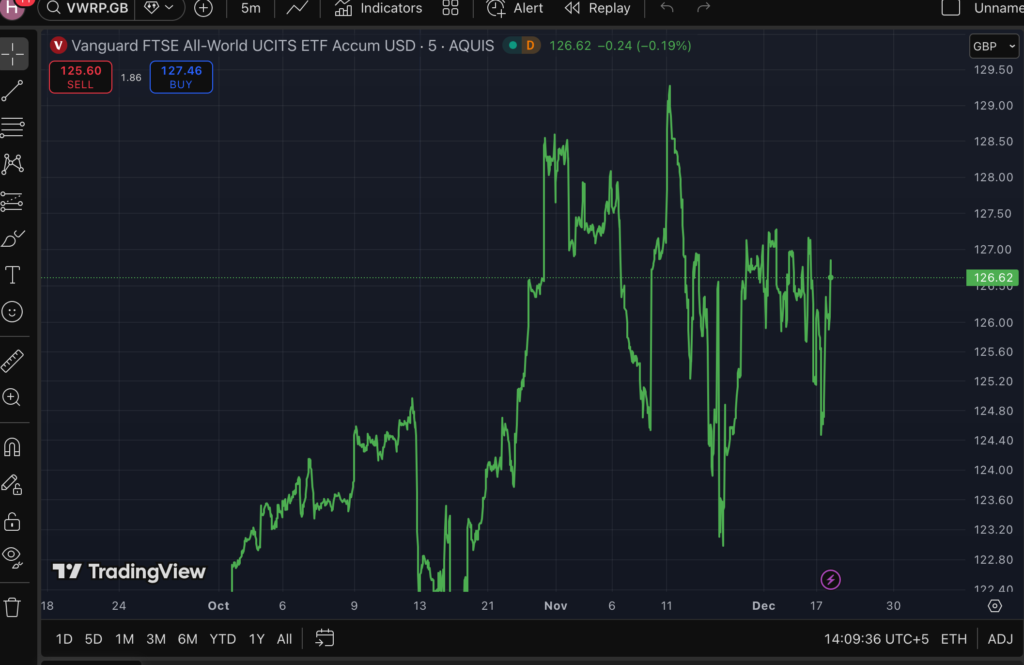
Looking at VWRP’s past performance helps investors understand how the ETF behaves in different market conditions. When I first started investing, I learned quickly that long-term charts tell a much clearer story than daily price movements. VWRP is built to follow global markets, so its performance reflects both strong years of growth and the challenging periods that every investor eventually faces.

Long-Term Trend

Over multi-year periods, global stock markets have generally moved upward, driven by company earnings, innovation, and economic expansion. VWRP captures all of this because it holds thousands of companies worldwide. When I looked back at long-term data before investing, I noticed that despite short-term volatility, the overall direction of global markets was positive. This helped me stay confident when prices dipped.

Bull and Bear Cycles

Like every equity-focused ETF, VWRP rises during strong market cycles and declines during global sell-offs. During times of fear—such as recession concerns or unexpected global events—it’s normal to see sharp pullbacks. I remember one period when markets dropped quickly; VWRP fell too, but it also recovered as global conditions improved. This reinforced the idea that patience matters more than timing.

Compounding Through Accumulation

Because VWRP automatically reinvests dividends, its historical chart reflects continuous compounding. As someone who prefers a simple, long-term approach, I appreciated how the accumulating structure turned small dividend payments into uninterrupted growth inside the fund. Over many years, this can make a noticeable difference.

What to Focus On


For beginners, historical performance isn’t about predicting the future. It’s about understanding how a globally diversified investment behaves over time. You’ll see periods of ups and downs, but you’ll also notice that broad global exposure tends to smooth out the impact of any single region or sector.

Whether markets rise or fall in the short term, VWRP’s long historical pattern shows why many long-term investors use it as a core holding: diversification, steady compounding, and broad exposure to global growth.

VWRP vs Close Alternatives

When I first compared VWRP with other global ETFs, I realized that many beginners get confused by how similar these funds seem. The truth is, the differences are simple once you break them down. Understanding them helps you choose the version that fits your personal investing style, taxes, and platform availability.

VWRP vs VWRL (Accumulating vs Distributing)

The biggest difference between these two Vanguard ETFs is how they handle dividends.

  • VWRP reinvests dividends automatically inside the fund.

  • VWRL pays dividends out to you in cash.

When I started investing, I preferred VWRP because I didn’t want to manage dividend payments manually. It allowed my portfolio to compound quietly in the background. Beginners who want simplicity often choose accumulating ETFs for this reason. But some investors prefer VWRL if they need dividend income or live in a country where cash payouts are taxed more favorably.

Both track the same FTSE All-World Index—same companies, same exposure—just different dividend treatments.


VWRP vs VWRA (Different Listing, Same Idea)

VWRA is another accumulating All-World ETF from Vanguard, but it is usually listed on different exchanges (commonly in USD).

The main differences are:

  • Listing currency

  • Exchange availability

  • Liquidity depending on the region

When I compared both, the performance was nearly identical over time because they track the same index and both reinvest dividends. For beginners, it usually comes down to which one your broker offers at a better cost and with lower currency conversion fees.

VWRP vs IWDA + EMIM (One Fund vs Two-Fund Strategy)

Some investors prefer to build a global portfolio using two ETFs:

  • IWDA (Developed Markets)

  • EMIM (Emerging Markets)

Together, they create similar exposure to VWRP. The benefit of this approach is control—you can adjust how much emerging markets you want. I tried this two-ETF method early on, but I eventually switched to VWRP for simplicity. Managing two funds and rebalancing them took more effort than I wanted for a long-term strategy.

Key differences:

  • The two-ETF combo gives more customization

  • VWRP gives full global coverage automatically

  • Fees and tracking differences are usually small

Beginners often find VWRP easier, while advanced investors sometimes prefer the two-fund method.

Which One Should You Choose?

From my experience, the choice depends on what you value:

  • Choose VWRP if you want a simple, hands-off global ETF with automatic compounding.

  • Choose VWRL if you want dividend payouts.

  • Choose VWRA if your broker offers cheaper trading conditions on that listing.

  • Choose IWDA + EMIM if you want control over how much emerging markets exposure you hold.

There’s no “wrong” choice here. All of these options track broad global markets—the difference is simply how active you want to be and how you prefer dividends to be handled.

For most beginners who want long-term, low-maintenance growth, VWRP usually fits naturally as a core holding.

How to Buy VWRP in 5 Simple Steps

Buying VWRP is straightforward once you understand the process. When I purchased my first ETF, I expected it to be complicated, but it turned out to be much easier than I imagined. These steps are designed for beginners and follow the same approach I used when I started investing.

Step 1: Choose a Regulated Broker

The first step is opening an account with a trusted, regulated brokerage platform. Make sure the broker offers access to the exchange where VWRP is listed (commonly the London Stock Exchange). A good broker should have:

  • Low trading fees

  • Low or zero account/custody fees

  • Clear currency conversion rates

  • An easy-to-use mobile and desktop platform

In my experience, choosing the right broker early saved me unnecessary costs over the long term.

Step 2: Deposit Funds Into Your Account

After creating your account, add funds using a payment method the broker supports. Some platforms offer bank transfers, debit card deposits, or even instant funding. I prefer bank transfers because they are usually cheaper and avoid extra fees.

If the ETF is listed in a different currency than your account, the broker will convert it when you buy. I learned quickly that FX fees matter, so it’s worth checking them before depositing.

Step 3: Search for “VWRP” on Your Broker

Every broker has a search bar where you can look up the ETF by ticker symbol. Type in VWRP and confirm you’re selecting the correct listing. What you should check:

  • Ticker: VWRP

  • Name: Vanguard FTSE All-World UCITS ETF (Accumulating)

  • Exchange: e.g., LSE (London Stock Exchange)

I always double-check the fund name to make sure I’m buying the accumulating version and not a similar fund.

Step 4: Decide Between Market Order or Limit Order

When placing your order, you usually have two basic options:

  • Market order: Buys at the current available price

  • Limit order: Lets you choose the maximum price you’re willing to pay

As a beginner, I often used market orders for large ETFs with tight spreads like VWRP, because execution was fast and the price difference was tiny. But limit orders can offer more control during volatile periods.

Step 5: Buy and Start Your Investment Plan

Once you confirm the order, your broker will process it and VWRP will appear in your portfolio. From here, you can keep things simple or build a strategy:

  • Monthly contributions (DCA)

  • Occasional lump-sum investing

  • Rebalancing with other ETFs if needed

When I started, I used a monthly DCA approach. It removed stress from the process and helped me stay consistent even when markets moved unpredictably.

Buying VWRP is one of the easiest ways to begin global, long-term investing. With the right broker and a simple plan, you can build a solid foundation for your portfolio without needing advanced knowledge or constant monitoring.

Best Brokers to Buy VWRP

Choosing the right broker is just as important as choosing the right ETF. When I first started investing, I didn’t pay enough attention to fees and platform features. Later, I realized that even small costs—like currency conversion charges or hidden account fees—can eat into long-term returns. Below is a breakdown of what to look for and the types of brokers that usually work well for beginners buying VWRP.


What Makes a Good Broker for VWRP

Before naming any specific platforms, it helps to understand the criteria that genuinely matter. These are the same points I wish I had known when opening my first account.

Regulation and Safety
Always choose a broker regulated in your region (FCA, SEC, ASIC, MAS, CySEC, etc.). This ensures your money is protected under strict financial rules. Avoid unregulated apps no matter how attractive they look.

Low Fees
Two costs matter most for VWRP buyers:

  • Trading commissions

  • Currency conversion fees

When I switched to a low-fee broker, I immediately noticed how much more efficient my DCA strategy became.

Access to the Right Exchange
Make sure your broker supports the VWRP listing you need, often the London Stock Exchange (LSE).

User-Friendly Platform
As a beginner, I found that having a clear interface made the whole process less stressful. Good brokers offer simple searching, clean charts, and smooth order placement.

Extra Features
Auto-invest, fractional shares, research tools, and low-cost deposits are a plus, especially if you plan to invest regularly.


Popular Broker Types (Choose Based on Your Needs)

Instead of listing specific brand names, here are the categories of brokers most investors use for ETFs like VWRP. You can insert the platforms you partner with later.


Broker Type A — Low-Cost Global Broker (Best for Long-Term Investors)

This type of broker usually offers the lowest trading fees and competitive FX rates. I use one of these for my long-term ETF investments.

Why beginners like this type:

  • Very low commissions

  • Tight spreads on major ETFs

  • Access to LSE and other key exchanges

  • Good for DCA and long-term portfolios

Pros:

  • Cheapest overall costs

  • Strong regulation

  • Wide range of ETFs and markets

Cons:

  • Some platforms feel more “professional” and less beginner-friendly


Broker Type B — Mobile Investing App (Best for Beginners)

Mobile-first brokers focus on simplicity. When I started, I preferred this type because it felt intuitive and easy to manage from my phone.

Why beginners like this type:

  • Clean interface

  • Simple deposit options

  • Easy to buy ETFs with a few taps

Pros:

  • Very user-friendly

  • Quick setup

  • Good educational tools

Cons:

  • FX fees can be higher

  • Limited advanced trading features


Broker Type C — Full-Service Broker (Best for Research & Tools)

Some investors prefer platforms that offer strong research, detailed charts, and analyst reports.

Why experienced investors like this type:

  • Powerful charting

  • Advanced order types

  • Detailed market data

Pros:

  • Excellent tools for learning and analysis

  • Good support

  • Often offers access to global markets

Cons:

  • Typically more expensive

  • Minimum deposit requirements may apply


Broker Type D — Fractional Shares Broker (Best for Smaller Budgets)

If you want to invest small amounts regularly, a broker that supports fractional ETFs can be helpful. This allowed me to stay consistent even when prices rose.

Pros:

  • Easy to DCA with small amounts

  • Clean app interfaces

  • Simple automation features

Cons:

  • Not all fractional brokers support every ETF

  • FX fees can vary


Broker Fee Comparison (What to Check Before You Choose)

Here are the fee categories that matter most. Even without specific broker names, you can use this like a checklist:

Fee TypeWhy It Matters
Commission per tradeImpacts frequent buyers and DCA.
FX markupAffects any ETF listed in a foreign currency.
Custody/platform feesSome brokers charge monthly or yearly.
Deposit/withdrawal feesAdds friction if you invest regularly.
SpreadWider spreads mean slightly worse prices.
Minimum depositHelpful for beginners with smaller budgets.

Whenever I compare brokers, FX fees are the first thing I check. Even a small percentage difference adds up over years of investing.


How to Pick the Right Broker for You

Here is a simple way to decide, based on my own trial-and-error experience:

  • Choose low-cost global brokers if you plan to invest for the long term with consistent contributions.

  • Choose mobile-first brokers if you prefer simplicity and ease of use.

  • Choose full-service brokers if research tools and advanced features matter to you.

  • Choose fractional brokers if your monthly investing budget is small.

The best broker is the one that fits your investing habits, not necessarily the one with the lowest headline fee. Consistency matters more over the long run than squeezing every tiny percentage point from costs.

A reliable, affordable broker makes buying VWRP easier, cleaner, and more cost-efficient—especially if you’re building a long-term global portfolio.

Smart Ways to Own VWRP (Beginner-Friendly Strategies)

Owning VWRP can be as simple or as structured as you want it to be. Over the years, I’ve tested different approaches—from buying whenever I remembered, to following a strict monthly plan. What I learned is that the strategy you choose matters almost as much as the ETF itself. Below are practical methods that work well for beginners and long-term investors.

Dollar-Cost Averaging (DCA)

DCA means investing a fixed amount on a regular schedule—weekly, monthly, or quarterly.
When I started, this was the approach that helped me the most. Instead of worrying about whether prices were “too high” or “too low,” I simply bought VWRP on the same date each month.

Why it works:

  • Removes emotion from investing

  • Reduces the stress of trying to time the market

  • Smooths out the impact of volatility

  • Works well with an accumulating ETF like VWRP

DCA helped me stay consistent, even when markets were swinging.

Lump-Sum Investing

Some investors prefer to invest a larger amount upfront. Historically, lump-sum investing has often produced stronger long-term returns because money stays in the market longer.
When I received a work bonus one year, I used a lump sum to boost my VWRP position and then continued with monthly DCA afterward.

Good for:

  • Investors who have cash ready to invest

  • Those comfortable with short-term market swings

Not ideal for:

  • Beginners who feel anxious about volatility

Blended Approach (My Preferred Method Today)

Over time, I found combining the two methods worked best for me:

  1. A lump sum when I had extra savings

  2. Ongoing DCA every month

This kept my portfolio growing steadily while making use of any spare capital.

Rebalancing With Other Assets

VWRP already covers global stocks, but you might want to balance it with:

  • Bonds

  • Cash

  • A regional ETF if you want a slight tilt

I rebalance once or twice a year—no complicated rules, just checking whether my allocations still match my goals.

Simple beginner rule:
If stocks rise too much and become a bigger part of your portfolio than you intended, scale them back. If they fall, buy a bit more.

Using Tax Wrappers

Depending on where you live, your country may offer tax-advantaged accounts (e.g., ISA, SIPP, 401(k), Roth IRA).
Whenever possible, I hold long-term ETFs like VWRP inside these accounts because:

  • You often avoid capital gains tax

  • Dividends (even reinvested ones) may be treated more favorably

  • Long-term growth compounds more cleanly

If you have access to such accounts, they can improve your total return.

Long-Term Mindset

VWRP is built for long time horizons—think years, not weeks.
The biggest lesson I learned: ignoring the daily noise gives better results than reacting to every market dip or headline.

Beginners who stay patient, invest consistently, and avoid emotional decisions usually see stronger long-term outcomes.

Smart ownership isn’t about predicting the next move. It’s about building a routine that fits your budget, your risk comfort, and your long-term vision. VWRP makes this easier by offering global diversification and automatic compounding in one ETF.

Risks and Things to Watch Before Investing in VWRP

Even though VWRP is one of the simplest and most diversified ETFs you can buy, it still carries risk. When I first started investing, I made the mistake of assuming that a global ETF meant “low risk.” Over time, I learned that understanding the risks helps you stay calm during market swings and avoid emotional decisions. Here are the key points beginners should know.

Equity Market Risk

VWRP is a global stock ETF. This means the price will go up and down with the world’s stock markets.
You will experience periods when:

  • Markets rally and VWRP climbs

  • Markets fall and VWRP drops, sometimes sharply

I remember my first market correction—seeing red numbers was uncomfortable. But later, those dips turned out to be opportunities as markets recovered. Short-term drops are normal, even in a diversified ETF.


Regional Concentration

Even though VWRP covers the whole world, certain regions—especially the United States—make up a large share of the index.
This means:

  • If U.S. tech stocks fall, you may see VWRP move noticeably

  • Some countries have a much smaller effect on the price

This is not a flaw, but something beginners should understand. Global markets don’t always move in perfect balance.


Currency Risk

This is one of the risks beginners often overlook.
VWRP owns companies earning money in different currencies, and the ETF itself is listed in various currencies depending on the exchange.

If your home currency strengthens, your return may look smaller.
If your currency weakens, your return may increase.

I learned this lesson after buying a foreign ETF—my returns fluctuated even when markets were flat. Currency swings are normal and part of global investing.


Market Liquidity and Spreads

VWRP usually has tight spreads and strong liquidity, especially on major exchanges like the LSE.
However, during periods of volatility:

  • Spreads may widen slightly

  • Buy/sell prices may move quickly

  • Limit orders may be more useful than market orders

During fast-moving markets, I’ve seen spreads widen for a short time. It wasn’t a big issue, but it reminded me not to panic-trade during volatility.


Tracking Difference

VWRP aims to match the FTSE All-World Index, but it may not be perfectly identical every year.
Small differences can happen because of:

  • Fees

  • Trading costs inside the fund

  • Dividend timing

  • Currency fluctuations

Tracking difference is usually small for a fund like VWRP, but beginners should know ETFs do not match the index exactly.


Regulatory and Tax Changes

Rules around ETFs, fund distribution, and foreign investment can change depending on your country.
For example:

  • Dividend tax rules may shift

  • Some jurisdictions adjust ETF regulations

  • Brokers may update their trading fees or FX costs

I check my local tax guidelines once a year, just to stay updated.


Long-Term Risk Mindset

The most important thing I learned: no ETF removes risk completely—not even highly diversified ones like VWRP. Global investing still comes with fluctuations, uncertainty, and emotional challenges.

But diversification, compounding, and time help smooth the journey.

If you understand the risks before investing, you’ll be better prepared to stay consistent and avoid decisions based on fear.


Taxes and Dividends for VWRP (Beginner-Friendly Explanation)

Taxes can feel confusing when you’re new to investing, but VWRP is easier to understand than most people expect. When I bought my first accumulating ETF, I wasn’t fully aware of how taxes worked. Over time, I learned the basics, and they apply almost the same way to VWRP. Here’s a clear, simple breakdown to help you stay informed without feeling overwhelmed.


VWRP Is an Accumulating ETF

VWRP does not pay dividends into your account.
Instead, the fund reinvests all dividends automatically. This reinvestment increases the ETF’s net asset value, which helps your investment grow without you needing to do anything.

I personally like this because it keeps things simple. I don’t need to reinvest or track dividend payments manually—the compounding happens inside the ETF.


Do You Still Pay Tax on Dividends?

This depends on your country.
Some countries tax reinvested dividends, even though you never receive the cash.
Others don’t tax you until you sell, or they may offer tax-free investment accounts.

What I learned from experience is that tax rules vary widely, so it’s important to check your local regulations or use a tax-advantaged account when possible.


Capital Gains Tax

When you eventually sell VWRP at a profit, you may owe capital gains tax depending on your country and the type of account you use.

Capital gains tax usually applies only to the profit you earned, not the entire sale amount.

If your country offers tax-free accounts (like an ISA or Roth-style account), holding VWRP inside one can remove this tax altogether. Whenever I have the option, I prefer using these accounts for long-term ETFs.


Foreign Withholding Tax

Because VWRP holds companies all over the world, some countries automatically take a small tax on dividends before they reach the fund. This is handled inside the ETF—nothing you need to do manually.

The key things to know:

  • This is normal for global ETFs

  • It doesn’t require personal paperwork

  • It typically has a small impact on returns

As a beginner, I worried this would be complicated, but in reality, it’s fully managed by the fund.


Tax Wrappers Make a Big Difference

Depending on where you live, using a tax-advantaged account can make VWRP even more efficient. Examples include:

  • ISA (UK)

  • SIPP / Pension accounts

  • Roth IRA / 401(k) equivalents

  • Other local tax shelters

When I moved my long-term ETFs into a tax-advantaged account, I immediately reduced the amount of tax I owed each year. Even small tax savings can add up over decades.


Keep Simple Records

Even with an accumulating ETF, it’s worth keeping:

  • Statements of your contributions

  • Records of purchases and sales

  • Annual summaries from your broker

These make it easier if you ever need to calculate gains or losses.


Key Takeaway for Beginners

VWRP makes dividend management simple because it reinvests everything automatically. Taxes depend on where you live, but in most cases, using tax-friendly accounts and keeping basic records is enough to stay compliant.

If you plan to hold VWRP for years—as many long-term investors do—understanding these basics will help you invest confidently without tax surprises later.

Frequently Asked Questions about VWRP

Clear answers for beginners looking at the VWRP share price, how it works, and how to invest safely.

Risk warning: Investing involves risk. The value of investments can go down as well as up, and you may get back less than you invest. This FAQ is educational, not personal advice.
What is VWRP in simple terms?
VWRP is an accumulating share class of a Vanguard ETF that tracks the FTSE All-World Index—thousands of global large- and mid-cap stocks in one fund. “Accumulating” means any dividends are reinvested inside the fund instead of paid out as cash.
Does VWRP pay dividends?
No. VWRP reinvests dividends automatically. You won’t see a cash payout; instead, the fund’s net asset value (NAV) reflects reinvested income over time. If you need cash distributions, look at the distributing sibling (often listed as VWRL).
Is VWRP the same as VWRL?
They target the same global equity exposure, but differ in payout policy. VWRP accumulates dividends; VWRL distributes them. Pricing, listings, and tax treatment can vary by your country and broker.
What moves the VWRP share price day to day?
Mainly the performance of global stocks in the underlying index, plus currency effects between the fund’s trading currency and company earnings currencies. Short-term supply/demand and trading spreads can also nudge the market price away from NAV.
Is there a minimum amount to invest in VWRP?
The practical minimum is usually the price of one share on your chosen exchange—unless your broker offers fractional shares or an auto-invest plan. Many beginner-friendly brokers now support fractional investing.
How do I buy VWRP through a broker?
Open a regulated brokerage account, fund it, and search for “VWRP”. Confirm the ticker and ISIN match the accumulating share class on your preferred exchange (e.g., LSE). Place a market or limit order, and consider setting a recurring purchase (DCA) if you invest monthly.
Is VWRP currency-hedged?
The common VWRP lines are unhedged. That means your returns are affected by currency movements as well as stock performance. If you prefer less currency swing, look for a hedged variant (naming and availability vary by region).
What fees should I expect with VWRP?
1) The ETF’s ongoing charge (TER), which is built into performance; 2) Your broker’s trading commission; 3) Any platform/custody fee; and 4) FX conversion costs if you trade in a different currency. Total cost depends on your broker and how often you trade.
Are there taxes on accumulating ETFs like VWRP?
Tax rules vary by country. Some jurisdictions tax reinvested income or capital gains differently from cash dividends. If you’re eligible, consider using tax-advantaged accounts (e.g., ISA/SIPP/401(k) equivalents). Always check local guidance or speak to a qualified professional.
Is VWRP a good core holding for beginners?
Many long-term investors use a global all-in-one ETF as a simple core. It’s diversified across regions and sectors, reducing single-stock risk. That said, suitability depends on your goals, time horizon, and risk tolerance. Consider pairing with cash or bonds for your comfort level.
Can I set up auto-invest or DCA into VWRP?
Yes—if your broker supports recurring buys or fractional shares. Dollar-cost averaging can smooth volatility and build the position over time. Check your broker’s scheduling and minimums.
Which exchange should I use to buy VWRP?
Pick the venue your broker offers with good liquidity and fair spreads (e.g., LSE). Factor in trading currency, your funding currency, and FX fees. Liquidity and costs can differ across exchanges.

Conclusion and Next Steps

VWRP is one of the most beginner-friendly ETFs available because it gives you global diversification, low fees, and automatic compounding in a single investment. When I first started building my portfolio, I wanted something simple that didn’t require constant monitoring or stock picking. VWRP quickly became a natural long-term core holding for that reason. It covers thousands of companies across major markets, reinvests dividends for you, and follows a straightforward passive strategy.

For new investors, the key is not to overcomplicate the process. Focus on choosing a reliable, low-fee broker, decide whether you want to invest monthly or through occasional lump sums, and let time work in your favor. Market ups and downs are normal, especially with global ETFs, but consistency matters far more than short-term fluctuations.

If you’re ready to take the next step, compare a few well-regulated brokers and choose the one that fits your budget, currency, and investing style. Once your account is set up, buying VWRP is quick and easy. Start small if you need to—what matters most is getting started and sticking to your plan.

Scroll to Top